
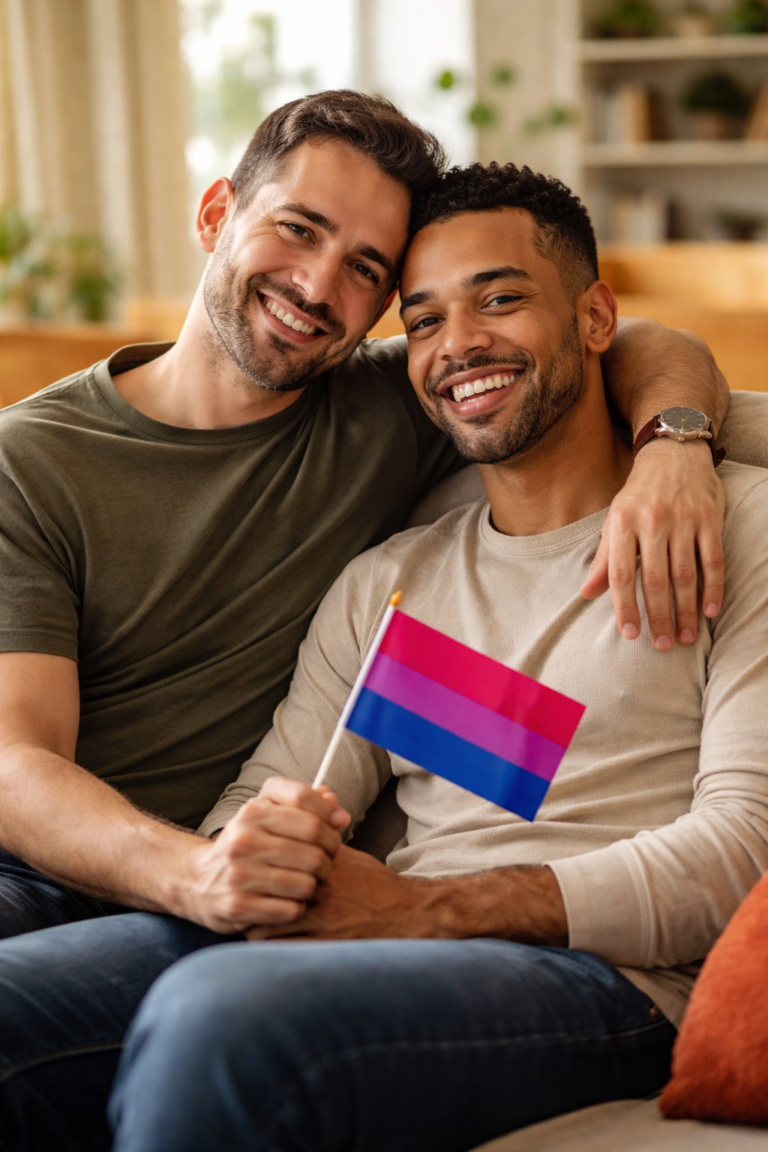
Living honestly. Loving fully. And refusing to disappear.
Married. A Man. Bisexual. Proud.
Mikial S. · Shoreditch, London
Read Mikial’s storyHide story
I am married to a man. I love him deeply. And I am bisexual.
For some people, those two truths feel contradictory. They aren’t. They coexist easily, honestly, and without apology in my life — even if society still struggles to hold them at the same time.
Being bisexual doesn’t disappear when you commit to one person. It doesn’t switch off because you’re married. It isn’t a “phase” you passed through on the way to something more acceptable or more understandable. It is who I am, whether I am single, partnered, married, or somewhere in between.
For me, being bi means my capacity for love has never been limited by gender. It means my emotional and romantic world has always been wider than the boxes people tried to place me in. Marriage didn’t erase that — it gave me a place where I could be fully myself, with someone who sees all of me and chooses me anyway.
In a relationship like mine, being bisexual means honesty. It means rejecting the myth that attraction equals action, or that commitment requires the erasure of identity. I don’t need to deny parts of myself to be faithful. I don’t need to rewrite my story to make others comfortable. My marriage is built on trust, communication, and respect — not on pretending I’m something I’m not.
And yet, bisexual people are often made invisible. Too queer for straight spaces. Too straight for queer ones. Questioned, doubted, joked about, or quietly erased. Even within LGBTQIA+ communities, we’re sometimes told we should “pick a side” — as if our existence is inconvenient or confusing.
That’s why Pride matters to me.
I celebrate Pride because visibility saves lives. Because younger bi people deserve to see futures that are stable, loving, and real — not just stereotypes or silence. Because Pride reminds us that authenticity is not something you give up when you settle down; it’s something you protect.
I celebrate Pride because my marriage does not make me less bi — and my bisexuality does not make my marriage less real.
I am proud of the love I share. I am proud of the identity I carry. And I am proud to support Capital Pride London — not as a contradiction, but as proof that bisexual lives are whole, valid, and worth celebrating.
Pride, for me, is simple: Living honestly. Loving fully. And refusing to disappear.
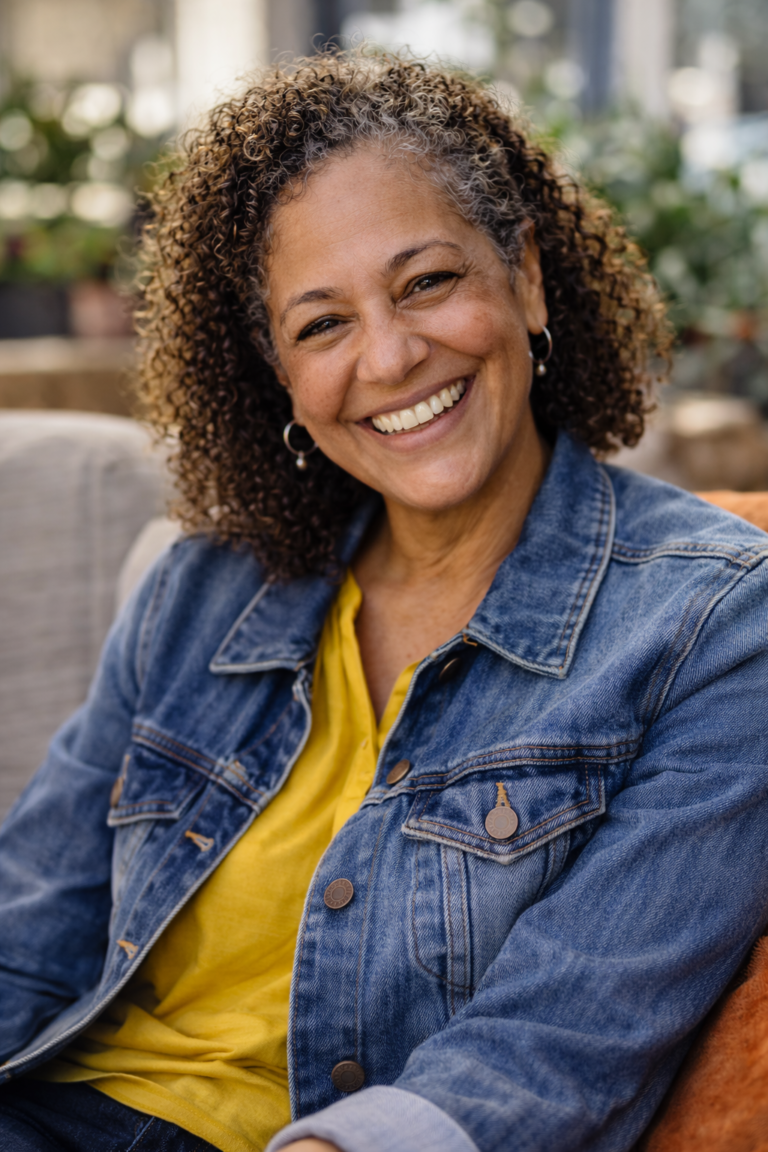
Coming out late doesn’t mean coming out too late.
Coming Out at 52
Jennifer M. · Blackheath, London
Read Jennifer’s storyHide story
I came out at 52.
For a long time, I thought that meant I was late — late to love, late to truth, late to myself. I wondered if I’d missed something essential. The firsts. The freedom. The version of life I didn’t let myself imagine.
But coming out late doesn’t mean coming out too late.
It means I arrived when I was ready. When I had the courage, the clarity, and the self-respect to choose honesty over fear. I didn’t miss my life — I survived long enough to finally live it.
Did I miss out on things? Maybe. But I also gained something powerful: perspective. I know who I am now. I don’t apologise for it. I don’t shrink it. I don’t negotiate it.
At 52, I still have so much life to live as a gay woman. So much joy to claim. So much love — for others, and for myself. I wake up lighter. I breathe deeper. I exist without hiding.
I am happy. I am liberated. And for the first time, I get to celebrate myself.
That is why I celebrate Pride. And that is why I stand proudly with Capital Pride London — because it is never too late to come home to who you truly are.
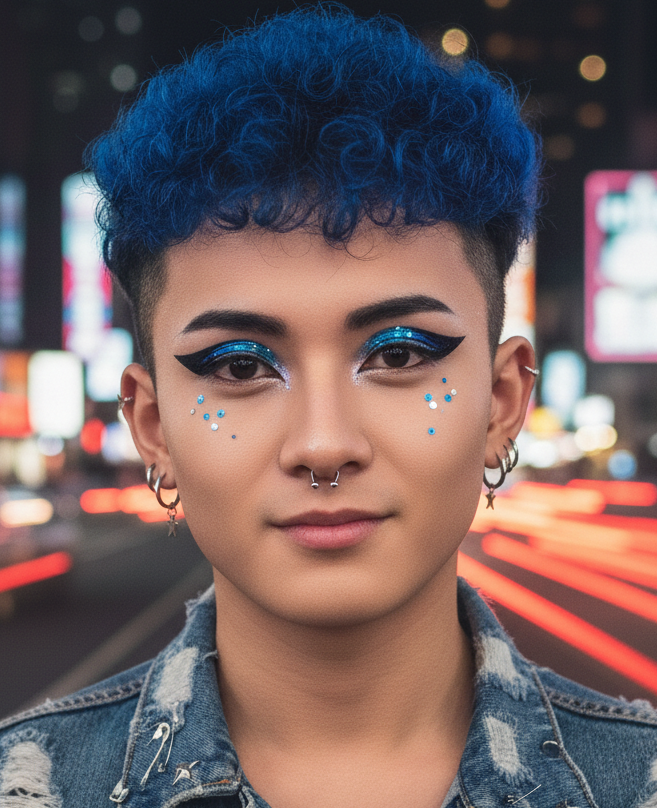
London gave me the permission I didn’t know I needed — to exist in between.
My Name Is Yu Ze
Yu Ze · Stratford, London
Read Yu Ze’s storyHide story
I didn’t arrive in London looking for answers about who I am. I arrived to study, to learn, to build a future.
What I found instead was space.
Back home, gender expression was something carefully managed. Not forbidden, just… contained. There were rules you absorbed without being taught. Ways of dressing, moving, existing that kept things simple and avoided questions.
London didn’t ask me to simplify myself.
Here, I watched people exist without explanation. Gender wasn’t something to justify or defend — it was something lived. Some days bold, some days quiet. Some days undecided. And somehow, that freedom felt contagious.
I started experimenting, not to label myself, but to listen to myself. Clothes became a form of curiosity rather than compliance. Expression became playful, then grounding. I stopped asking whether something was allowed and started asking whether it felt true.
Nothing dramatic happened. No announcement. No moment of arrival. Just a steady loosening.
I learned that gender expression doesn’t need an audience or a conclusion. It can shift with mood, with safety, with time. It can exist without needing to be named.
London gave me the permission I didn’t know I needed: to exist in between, to change, to take up space on my own terms.
I am Yu Ze. Still studying. Still learning. And finally allowing myself the freedom to be unfinished.
I chose myself, and in doing so, I finally found a life that is actually mine.
Unlearning the Amen
Kenneth S. · West Norwood, London
Read Kenneth’s storyHide story
The wooden pews didn’t just hold my body; they held the weight of a thousand things I couldn’t say. As a twenty-year-old with skin the colour of polished mahogany and a voice that anchored the choir’s bass section, the church was my entire world, but I was beginning to realise it was also my cage. I had come to faith at eighteen because I was lonely and looking for a place to belong, but the moment I confessed my struggle to the minister, everything changed. He didn’t offer comfort; he told me I was possessed, a perversion, and — cruellest of all — a potential danger to children. I was desperate not to lose my faith or my community, so when he suggested I meet some people who had “experience” with people like me, I went.
The “intervention” didn’t happen in a grand sanctuary. It happened in a rented room above a shop on a Birmingham high street, a space that smelled of stale tea and industrial cleaner. I thought I was there for prayer, but the moment the door clicked shut, the atmosphere curdled. There were three of them. They didn’t use physical chains; they used the far stronger shackles of spiritual bullying. They became aggressive, their voices overlapping and rising in volume until the room felt too small for my lungs. They shouted that I only existed because of abuse. When I tried to stand up and tell them it was rubbish, they shoved me back down. I ended up on the floor, the thin carpet burning my knees, while they commanded the identity out of me, again and again, as they prayed.
I was terrified. To make it stop, I lied. I pretended it had worked, that I was “delivered,” and I ran to my car and sobbed until I felt hollow. For years after, I lived that performance. I married a woman I loved as a friend, hoping the “cure” would finally take hold, and I even trained as a minister myself, hiding the truth so deep that I began to hate my own reflection. I lived in a cycle of “monitoring” and threats, told that if I didn’t comply, I’d be outed to the entire congregation. The shame was a slow-acting poison, making me feel dirty and worthless even while I stood at the pulpit.
The turning point wasn’t a sudden miracle, but a weary realisation that I couldn’t breathe anymore. I saw that the racism and sexism I was told to “accept” in the church were the same tools being used to crush my identity. I decided to survive. When I finally came out and left that world, it wasn’t easy — I faced more abuse and more threats. But for the first time in decades, the weight was gone. I moved away and began the gruelling, unpolished work of unlearning the idea that I was an abomination. I am a survivor of a system that tried to break my soul to save its own traditions. I carry the scars of that room in Birmingham — the flinch at loud voices, the occasional surge of unmerited guilt — but I carry them as proof that I am still here. I chose myself, and in doing so, I finally found a life that is actually mine.
 English