
The Manufactured Divide: A Closer Look at the Amnesty International UK Briefing on Media Bias and Trans Rights
A media landscape transformed
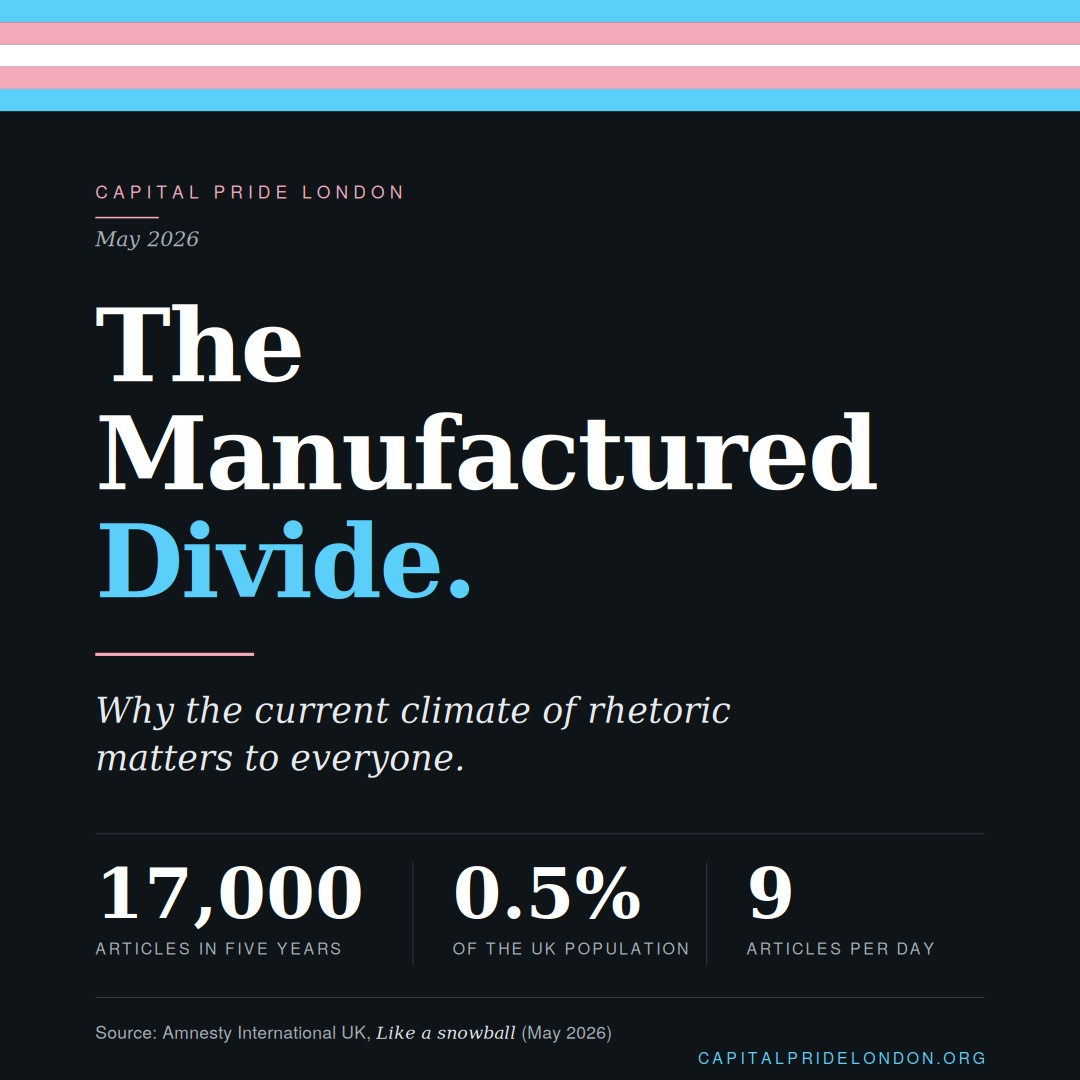
Over the past five years, the way our media talks about trans people has changed dramatically. If you have felt that “trans issues” are suddenly everywhere, you aren’t imagining it. A new investigative briefing by Amnesty International UK, Like a snowball: the growth and impact of the gender critical movement in the UK (May 2026), highlights just how stark this shift has been. According to the report, between January 2020 and April 2025, four major national newspapers published a staggering 17,000 articles on the subject—an average of nine every single day.
For us at Capital Pride London, these figures are not just statistics; they represent a significant shift in our public culture. It is important to note that trans people make up just 0.5% of the UK population. Yet, as the Amnesty report details, the media’s relentless focus on this community is starkly disproportionate, often framing these stories around controversy, conflict, or harm rather than the lived realities of our community members.
The missing voices
Perhaps the most concerning finding in the Amnesty research is the near-total erasure of trans voices from these stories. When trans people are mentioned, it is rarely to hear their perspectives; they are far more likely to appear only as victims of crimes or within inflammatory contexts. Instead, the debate is overwhelmingly dominated by high-profile politicians and a newly organised, well-resourced network of groups that have emerged since 2017.
A manufactured movement
This is not an organic shift in public opinion. The Amnesty briefing reveals the emergence of a “gender critical” (GC) movement that has grown rapidly in the last few years. While these organisations often present their work as common-sense advocacy, the report outlines how they share core objectives: to restrict legal gender recognition, challenge bodily autonomy, and push for the exclusion of trans people from public spaces.
Why it matters beyond the trans community
At Capital Pride London, we recognise that these tactics have wider implications. The arguments currently used to target trans rights—such as questioning the principle of “Gillick competence” for young people or challenging bodily autonomy—frequently overlap with wider efforts to roll back reproductive rights and other hard-won freedoms, as noted in the report’s analysis. By framing our community’s humanity as a political battleground, these campaigns seek to normalise exclusionary language and rewrite the rules on whose lives deserve protection.
The impact of this environment is tangible. The Amnesty report highlights that hate crimes against trans people have seen worrying increases over the same period, and the constant negative media narrative contributes to a climate of fear and hostility.
Standing in solidarity
Pride has always been about more than just a parade; it is a movement built on the foundation that our equality is not divisible. When one part of our community is systematically marginalised, it undermines the safety and dignity of us all. We must reject this manufactured division and stand in solidarity with our trans family. True progress requires us to demand better from our press and our political leaders—and to ensure that the stories defining our lives are told with the dignity, nuance, and humanity they deserve.
Amnesty Internatioal Report – Like a Snowball
 English
Leave a Reply