
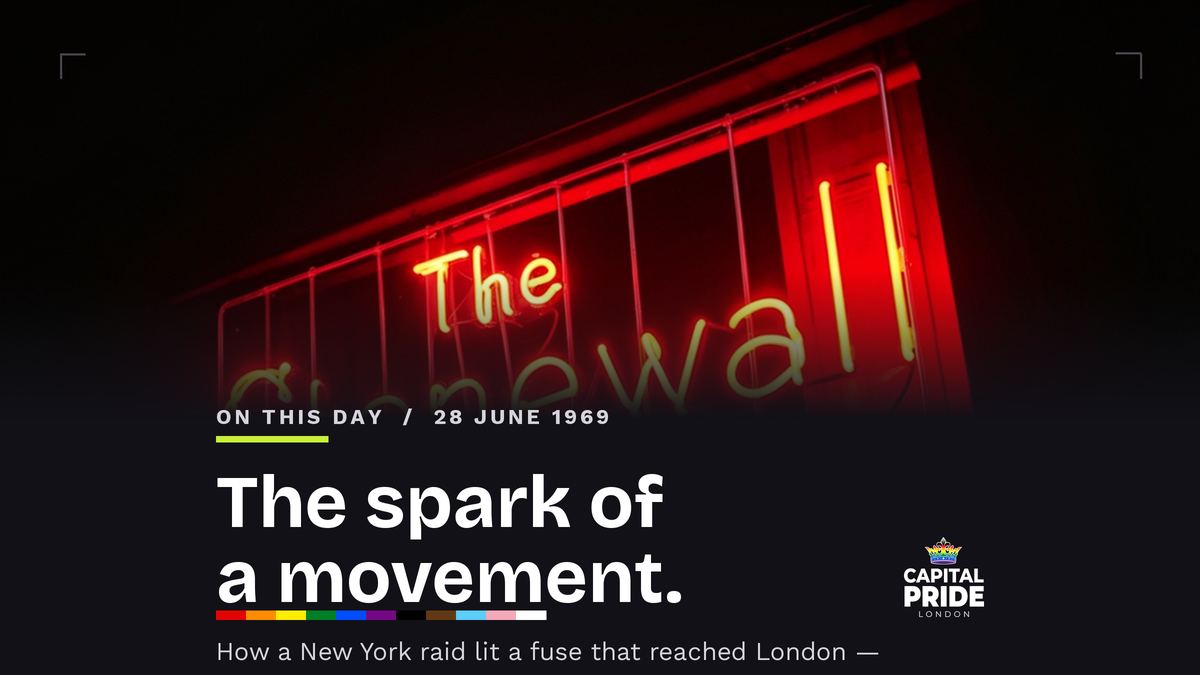
The spark of a movement: Stonewall and the UK it lit
Tomorrow marks the anniversary of the Stonewall uprising. In the early hours of 28 June 1969, police raided the Stonewall Inn, a small, scruffy gay bar in Greenwich Village, New York. Raids like it were routine. What wasn’t routine was what happened next: the people inside, and then the crowd outside, decided they’d had enough — and didn’t go home quietly. The resistance ran for days.
It’s an American story. But it’s a British one too, and that second half tends to get lost.
Who actually lit it
It matters who was at the front. Stonewall wasn’t sparked by the most respectable, most comfortable members of the community. It was sparked by the people usually pushed to the edges — trans women of colour, drag queens, butch lesbians, homeless young people, sex workers. Names like Marsha P. Johnson, Sylvia Rivera and Stormé DeLarverie belong at the centre of it, not as footnotes.
That’s worth holding onto, because the same pattern repeats everywhere a movement begins: the people with the least to lose, and the most to risk, are the ones who move first.
How the spark crossed the Atlantic
Britain didn’t watch from a distance. Activists who had seen the American movement up close came home fired up — and in October 1970, the UK’s own Gay Liberation Front met for the first time, in a basement classroom at the London School of Economics.
Two years later, on 1 July 1972, Britain held its first Pride march. London. A few hundred people walking from Trafalgar Square to Hyde Park, deliberately scheduled for the Saturday closest to the Stonewall anniversary. Walking it then took real nerve — this was public, named, photographable, at a time when being out could cost you your job, your home, your family. They did it anyway.
Why we don’t just import the date
Here’s the nuance, though. The UK didn’t simply copy and paste an American moment.
Our movement was sparked by Stonewall but shaped by British conditions. Sex between men had only been partly decriminalised in England and Wales in 1967 — and not in Scotland until 1980, or Northern Ireland until 1982. The fight here had its own timeline, its own enemies, and worse was still to come: Section 28 was only sixteen years away. So the British movement borrowed the spark, then had to build its own fire, for its own weather.
That’s the honest version. Not a borrowed holiday — a shared beginning, carried forward on home ground.
Why the spark still matters
A movement is not a monument. It isn’t something that happened once, safely, in the past, that we now visit politely each June.
The reason we mark Stonewall is not nostalgia. It’s a reminder of where the courage came from — the margins — and a nudge to ask who’s at the margins now, and whether we’re standing with them or just inheriting the applause they earned.
So as Pride month closes, that’s the thought we’d leave you with. The people who lit this had the least cover and the most to lose. The least we owe them is to keep the fire going, and to make sure the people still on the edges aren’t holding it alone.
— Capital Pride value: Honouring Our Roots.
 English
Leave a Reply